Other Publications
Education Columns
The Effectiveness of “Residency Launch” Onboarding for New Interns Entering a Family Medicine Residency
By Morgan Lisner, MD, FAAFP; Ally Bray, MD; Esteban Garza, MD; Jacob Huegel, MD; Catherine Reid, DO; Will Moore, MD; Rebecca Rdesinski; Mary K Nordling, MD, FAAFP; OHSU-Hillsboro Family Medicine Residency Program, Hillsboro, OR
Introduction
Family medicine (FM) encompasses a broad scope of practice requiring knowledge in pediatrics, chronic disease management, urgent and emergent care, obstetrics and gynecology, procedures, dermatology, and more. Practice in FM likewise requires clinicians to maintain a wide range of skills to meet the needs of their patients. For incoming interns, acquiring this skill set may seem daunting. The goal of our project was to create a “Residency Launch” curriculum designed to provide a standardized skill set to each new intern. Focusing primarily on procedures and obstetrical care, the program incorporated workshops, lectures, electronic medical record training, and shadowing experiences to orient interns to various aspects of FM. Prior studies of “residency launch” or “boot camp” courses for incoming surgical or internal medicine interns—designed to standardize skill sets—have shown improvements in confidence levels.1-4 During our literature review, we found no similar studies in FM. Given the breadth of FM training, we hypothesized that FM interns would benefit from a comparable experience.
Approach
Our residency program was established in 2021, and during the first 2 years, orientation was modeled on onboarding curricula previously developed and used by our program director at other institutions. In 2023, we redesigned our curriculum with input from current residents and have continued Plan-Do-Study-Act (PDSA) cycles annually with modest modifications. The curriculum includes morning shadowing sessions and continuity clinics followed by afternoon lecture and workshop sessions.
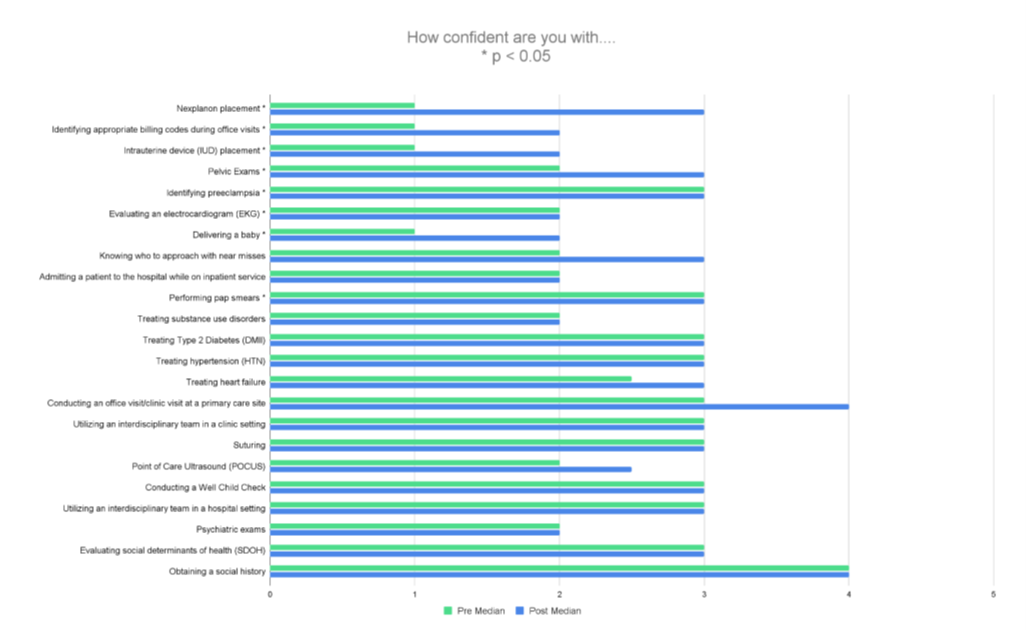
During shadowing sessions, incoming interns observed residents on the inpatient, pediatric, and obstetric services as well as in the outpatient clinic. The purpose of these sessions was to familiarize interns with the workflow of these rotations. Afternoon sessions included didactic lectures on common clinical conditions (eg, hypertension, heart failure) and hands-on workshops (eg, obstetrical procedures, suturing). Interns rated their confidence in the topics covered during Residency Launch using a 5-point Likert scale administered before and after the curriculum via an anonymous survey. To date, 40 FM interns have completed our curriculum, 16 of whom participated in the updated version developed through resident feedback.
Results
Compared with pre-course levels, interns reported significant increases in confidence related to procedural skills, including performing deliveries (P = .03), placing Nexplanon or intrauterine devices (P = .01), performing Papanicolaou tests (P = .02), and conducting pelvic examinations (P = .01).
Conclusion
Prior studies have shown that intensive orientation courses are associated with increased confidence levels among surgical and internal medicine interns. Our results illustrate similar benefits for FM interns, particularly in obstetrics and procedural skills. We have used these findings internally to refine our Residency Launch curriculum for subsequent classes. Moving forward, we aim to continue strengthening this introductory experience to better prepare FM interns for the demands of residency and to enhance their confidence as they enter the next phase of training.
References
1. Dversdal RK, Gold JA, Richards MH, et al. A 5-day intensive curriculum for interns utilizing simulation and active-learning techniques: addressing domains important across internal medicine practice. BMC Res Notes. 2018;11(1):916. doi:10.1186/s13104-018-4011-4
2. Krajewski A, Filippa D, Staff I, Singh R, Kirton OC. Implementation of an intern boot camp curriculum to address clinical competencies under the new Accreditation Council for Graduate Medical Education supervision requirements and duty hour restrictions. JAMA Surg. 2013;148(8):727-732. doi:10.1001/jamasurg.2013.2350
3. Pliego JF, Wehbe-Janek H, Rajab MH, Browning JL, Fothergill RE. OB/GYN boot camp using high-fidelity human simulators: enhancing residents’ perceived competency, confidence in taking a leadership role, and stress hardiness. Simul Healthc. 2008;3(2):82-89. doi:10.1097/SIH.0b013e3181658188. PMID: 18580207
4. Wright D, Bailer J, Hall A, Lindsey H, Wyatt B. Pilot study: increasing confidence in obstetrics and gynecology applicants through a prep course prior to audition rotations. Cureus. 2022;14(8):e27793. doi:10.7759/cureus.27793. PMID: 36106289