Other Publications

Education Columns

Encouraging Family Medicine Resident Community Engagement Through a Local High School Partnership Program

By Marissa Bruno, DO, St Charles Health System, Bend, OR; Lisa Huynh, DO, OHSU Health Hillsboro Medical Center, Hillsboro, OR; Mary K. Nordling, MD, OHSU Health Hillsboro Medical Center, Hillsboro, OR; Rebecca Rdesinski, MSW, MPH, OHSU Health Hillsboro Medical Center, Hillsboro, OR

BACKGROUND

Community partnerships during residency training may provide valuable educational experiences for resident physicians ¹ and may help generate interest in health care career pathways while reducing barriers for youth.² This project aimed to address barriers to entering health care careers by directly engaging high school–aged youth through incorporation of community engagement experiences into residency curricula. The study sought to evaluate high school students’ interests and perceptions regarding health care careers and their understanding of the role of family medicine resident physicians. In addition, the project evaluated how family medicine residents perceived the impact of community engagement on their own educational experience.

METHODS

Using a pre–post study design, confidential surveys were distributed to students enrolled in a sports medicine class at Hillsboro High School and to family medicine residents at Hillsboro Medical Center during three interactive educational workshops. Workshops were facilitated by family medicine residents on-site at Hillsboro High School. Each session covered a different topic. The first session was a question-and-answer discussion in which students asked about resident physicians’ paths into medicine, recommendations for college classes or majors, volunteer and service opportunities, the breadth of family medicine, and the day-to-day work of a resident physician. Additional workshops included sessions on suturing and point-of-care ultrasound.

Pre- and post-surveys were administered to students and residents before and after the workshop series. For students, survey items assessed interest, attitudes, and perceived barriers to health care careers as well as understanding of the scope of family medicine. For residents, survey items assessed perceptions of how community engagement might enhance residency education. Data were analyzed using SPSS, version 30.

RESULTS

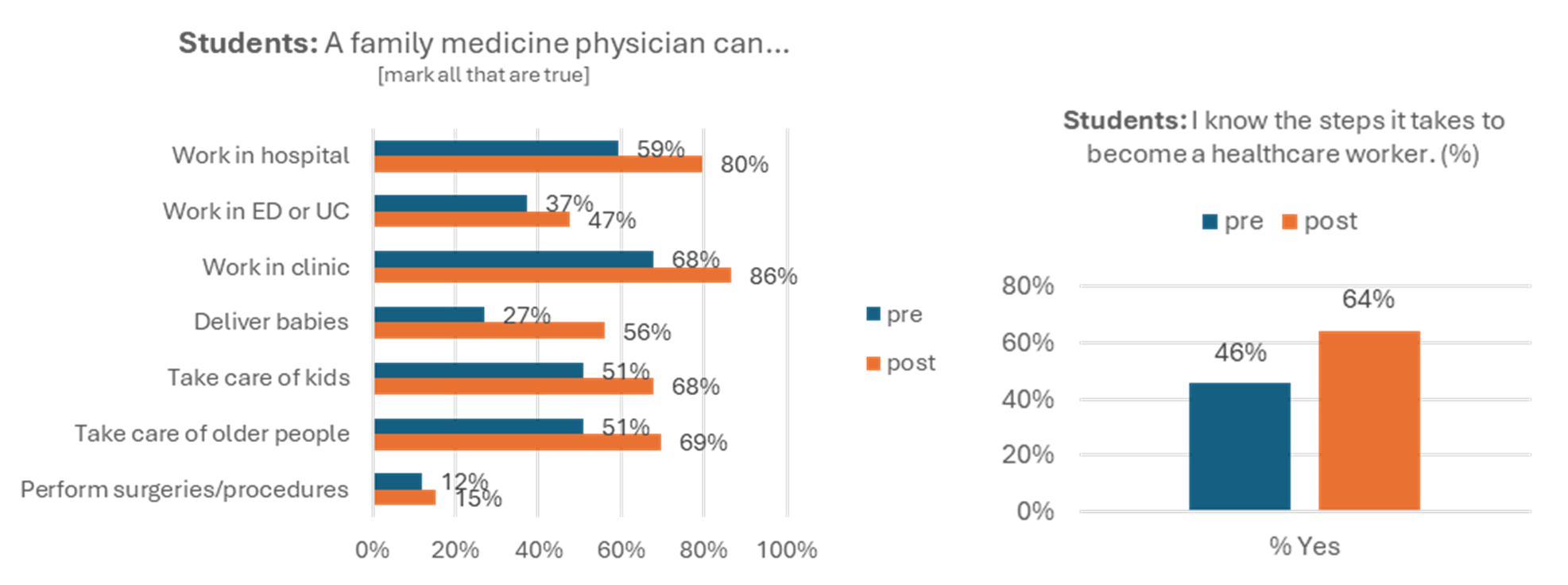
A total of 58 students completed the pre-workshop surveys and 55 completed the post-workshop surveys. There was a statistically significant increase in agreement with the statements “I have met a resident physician/doctor” and “I know what a resident physician does.” Students also demonstrated an overall increase in knowledge regarding the scope of family medicine and the steps required to pursue a health care career.
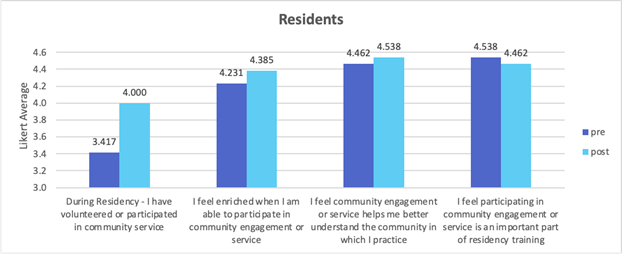
Seventeen family medicine residents completed the pre-workshop surveys and 15 completed the post-workshop surveys. Although most increases were not statistically significant, there was an overall increase in agreement with statements indicating that community engagement (1) helps residents better understand the community, (2) is an important part of residency training, and (3) is enriching to residents who participate. The only statistically significant increase agreed with the statement, “During residency, I have volunteered or participated in community service.” 
DISCUSSION

This collaboration between a local high school and family medicine resident physicians was developed to assess the impact of community engagement on both students and residents. Student pre–post survey results demonstrated increased knowledge of health care career pathways, family medicine scope of practice, and the roles of resident physicians. Resident survey results showed overall agreement that community engagement is valuable for understanding the community and enriching residency training. These findings suggest that this model may be a promising approach to connecting youth with resident physicians while enhancing resident education.

Dr Bruno and Dr Huynh are graduates of the OHSU Hillsboro Family Medicine Residency and participated in this project during their second and third years of training. Dr Nordling served as the residency program director, and Ms Rdesinski is a member of the research team in the Department of Family Medicine at Oregon Health & Science University.

REFERENCES

  1. Lochner J, Lankton R, Rindfleish K, Arndt B, Edgoose J. Transforming a family medicine residency into a community-oriented learning environment. Fam Med. 2018;50(7):518-525. doi:10.22454/FamMed.2018.118276
  2. Wilkins CH, Alberti PM. Shifting academic health centers from a culture of community service to community engagement and integration. Acad Med. 2019;94(6):763-767. doi:10.1097/ACM.0000000000002711

Contact Us

11400 Tomahawk Creek Parkway

Leawood, KS 66211

(800) 274-7928

stfmoffice@stfm.org 


Ask a Question
AI Chatbot Tips

Tips for Using STFM's AI Assistant

STFM's AI Assistant is designed to help you find information and answers about Family Medicine education. While it's a powerful tool, getting the best results depends on how you phrase your questions. Here's how to make the most of your interactions:

1. Avoid Ambiguous Language

Be Clear and Specific: Use precise terms and avoid vague words like "it" or "that" without clear references.

Example:

Instead of: "Can you help me with that?"
Try: "Can you help me update our Family Medicine clerkship curriculum?"
Why this is important: Ambiguous language can confuse the AI, leading to irrelevant or unclear responses. Clear references help the chatbot understand exactly what you're asking.

2. Use Specific Terms

Identify the Subject Clearly: Clearly state the subject or area you need information about.

Example:

Instead of: "What resources does STFM provide?"
Try: "I'm a new program coordinator for a Family Medicine clerkship. What STFM resources are available to help me design or update clerkship curricula?"
Why this is better: Providing details about your role ("program coordinator") and your goal ("design or update clerkship curricula") gives the chatbot enough context to offer more targeted information.

3. Don't Assume the AI Knows Everything

Provide Necessary Details:The STFM AI Assistant has been trained on STFM's business and resources. The AI can only use the information you provide or that it has been trained on.

Example:

Instead of: "How can I improve my program?"
Try: "As a program coordinator for a Family Medicine clerkship, what resources does STFM provide to help me improve student engagement and learning outcomes?"
Why this is important: Including relevant details helps the AI understand your specific situation, leading to more accurate and useful responses.

4. Reset if You Change Topics

Clear Chat History When Switching Topics:

If you move to a completely new topic and the chatbot doesn't recognize the change, click the Clear Chat History button and restate your question.
Note: Clearing your chat history removes all previous context from the chatbot's memory.
Why this is important: Resetting ensures the AI does not carry over irrelevant information, which could lead to confusion or inaccurate answers.

5. Provide Enough Context

Include Background Information: The more context you provide, the better the chatbot can understand and respond to your question.

Example:

Instead of: "What are the best practices?"
Try: "In the context of Family Medicine education, what are the best practices for integrating clinical simulations into the curriculum?"
Why this is important: Specific goals, constraints, or preferences allow the AI to tailor its responses to your unique needs.

6. Ask One Question at a Time

Break Down Complex Queries: If you have multiple questions, ask them separately.

Example:

Instead of: "What are the requirements for faculty development, how do I register for conferences, and what grants are available?"
Try: Start with "What are the faculty development requirements for Family Medicine educators?" Then follow up with your other questions after receiving the response.
Why this is important: This approach ensures each question gets full attention and a complete answer.

Examples of Good vs. Bad Prompts

Bad Prompt

"What type of membership is best for me?"

Why it's bad: The AI Chat Assistant has no information about your background or needs.

Good Prompt

"I'm the chair of the Department of Family Medicine at a major university, and I plan to retire next year. I'd like to stay involved with Family Medicine education. What type of membership is best for me?"

Why it's good: The AI Chat Assistant knows your role, your future plans, and your interest in staying involved, enabling it to provide more relevant advice.

Double Check Important Information

While the AI Chat Assistant is a helpful tool, it can still produce inaccurate or incomplete responses. Always verify critical information with reliable sources or colleagues before taking action.

Technical Limitations

The Chat Assistant:

  • Cannot access external websites or open links
  • Cannot process or view images
  • Cannot make changes to STFM systems or process transactions
  • Cannot access real-time information (like your STFM Member Profile information)

STFM AI Assistant
Disclaimer: The STFM Assistant can make mistakes. Check important information.