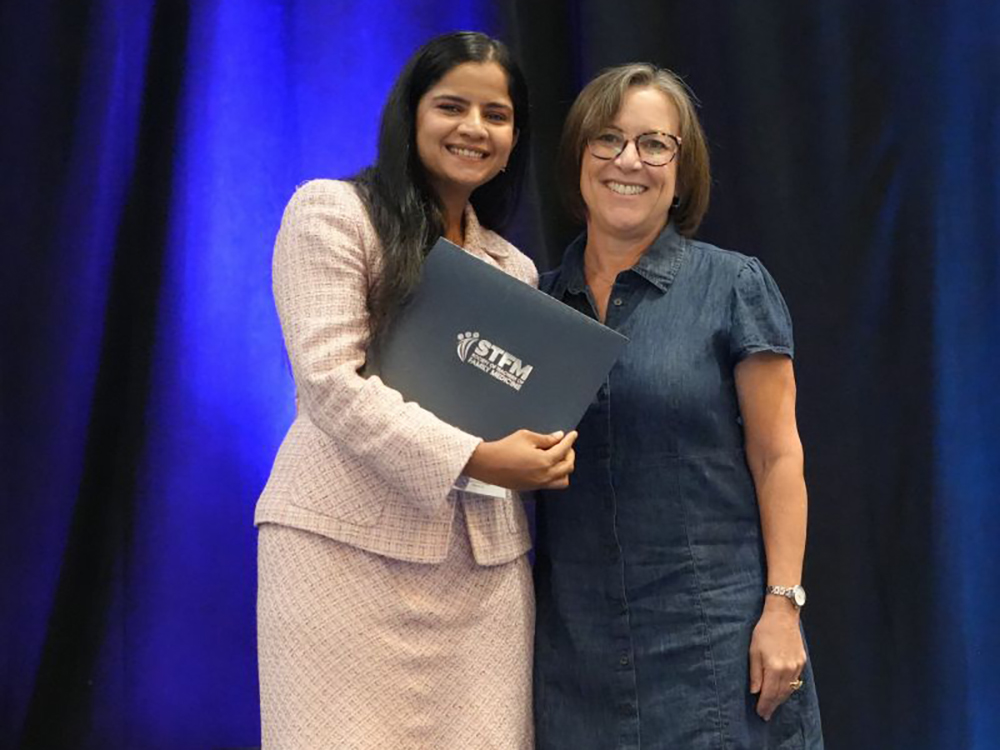
Overview of the H. Winter Griffith Resident Scholarship
The H. Winter Griffith Resident Scholarship honors H. Winter Griffith, MD, who was an advocate for patient engagement through patient education. Thus, this award recognizes outstanding patient interaction, education, care, and outcomes by a resident or resident team in the family medicine medical home setting.
Scholarship Details
A $1000 scholarship will be awarded to the winning resident or resident team, along with an award certificate, and a complimentary registration (or up to two complimentary registrations will be provided for a resident team) to the Conference on Practice & Quality Improvement. The resident(s) will also be recognized at the conference, and invited to present their work as a distinguished poster.The award winner(s) will be notified in late July.
Judging Scholarship Entries
Entries will be judged on the following:
- The extent to which the project emphasized improvements in patient-centered care
- Effectiveness or outcomes of the project
- Feasibility of the improvement project for dissemination to other health centers or systems
How to Apply, Eligibility, and Criteria
How to Apply
The application deadline for the H. Winter Griffith Resident Scholarship is June 30 each year.
Send the following, as a single pdf, to Melissa Abuel at mabuel@stfm.org:
- Resident(s) name, residency program, address, email address, and phone number
- One paragraph describing the activity (250-word maximum) for use in the conference brochure
- A description of the quality improvement work, including the objectives and the outcomes of the project:
- Applicant must demonstrate what performance improvement methodologies were used and include a clearly identified patient-centered problem, the “aim(s)” for improvement, and what measures were selected.
- Application should include how data was used. Examples: How measurements and iterative tests of change were made; tactics for change management; approach to team-based collaborative learning
- Applicant must provide data showing meaningful patient-centered improvement over time (for instance, through the use of run charts or data tables).
- Letter from the resident or resident team indicating a willingness to present their work as a poster at the STFM Conference on Practice & Quality Improvement
- Letter of recommendation and support from the resident's or resident team's program director
Eligibility
Entries are limited to family medicine residents involved in quality improvement work focused on improving patient-centered care. The following items are further eligibility criteria:
- The practice improvement activity should document a change in:
- Patient knowledge, engagement, or self-management
- Team-based environment and systems of care
- Quality or safety of health care
- Ability to provide examples of patient-centered practice improvement activities include patient surveys, focus groups, motivational interviewing, self-management support, shared goal setting, health coaching, innovative use of media or communication technology, patient portals, e-visits, or behavior change activities
Note: Individuals who have received an award at the STFM Conference on Practice & Quality Improvement within the past 3 years are not eligible to receive this scholarship.
Scholarship Criteria
The following are the three different focus types for quality improvement work that could be awarded the scholarship.
Focus: Scope of Improvement Activity
The practice improvement activity should document a change in one of the following:
- Patient knowledge, engagement, or self-management
- Team-based environment and systems of care
- Quality or safety of health care
Focus: Application of PI Methodology
Applicant must demonstrate what performance improvement methodologies were used and include a clearly identified patient-centered problem, the “aim(s)” for improvement, and what measures were selected.
In addition, the application should include how data was used. Examples are:
- How measurements and iterative tests of change were made
- Tactics for change management
- Approach to team-based collaborative learning
Focus: Data Showing Improvement
Application must include data showing meaningful patient-centered improvement over time (for instance, through the use of run charts or data tables).
Past Scholarship Recipients
2022–2026 Scholars
- 2026: Komal Gangar, MBBS, MD, University of Arkansas for Medical Sciences
- 2025: Emanuel Salcedo, MD, University of California San Francisco Valley Health Family and Community Medicine Residency
- 2024: Ashten Duncan, MD, MPH, CPH, University of New Mexico-Santa Fe Family Medicine Residency
- 2023: Vincent Lau, DO, Rutgers-RWJUH Somerset Family Medicine Residency Program
- 2022: Heran Abiye MD, HCA Medical City Arlington Family Medicine
2018–2021 Scholars
- 2021: Resident Team, Riverside University Health System/University of California, Riverside, Moreno Valley, CA
- 2020: Teena Dcruz, MD, Mount Carmel Health Systems, Westerville, OH
- 2019: Andrew Telzak, MD, Montefiore Medical Center
Team: Yu (Jen) Lun, MD, Ashley Meyr, MD, Deanna Chavez, MD, Saint Louis University-Family Medicine Residency, St Louis, MO - 2018: Team: Oluwaseun Acquah, MD and Amanda Honsvall Hoefler, MD
2014–2017 Scholars
- 2017: Team: Julie Antonova, Megan Chock, Nichole Hansen-Cruz, Peifen Sophia Hu, Joshua Wilner, Lisa Zampello
- 2016: Team: Jessica Bossie, MD, Nora Lamartine, MD, Ivonne McLean, MD, and Pamela Sansoucy, MD
- 2015: Team: Lindsay Martin-Engel MD MPH, Jacqueline Allen Trenier MD MPH, Amber Grove de Alencar MD MPH. Rebecca Eary MD MPH, Naomi Nemoto MPH
- 2014: Juan Robles, MD
2010–2013 Scholars
- 2013: Russell Ballard, MD, MPhil
- 2012: Jeffery Cushman, MD
- 2011: Erik Gulbrandsen, DO
- 2010: Ravishankar Ramaswamy, MD, MS
Legacy of H. Winter Griffith
H. Winter Griffith, MD, was a physician who authored 27 medical books. His books are renowned for being easy for patients to read and understand.Dr Griffith’s dedication to patient care and education inspired STFM to create the H. Winter Griffith Award in 1990. This award, which evolved into the H. Winter Griffith Resident Scholarship in 2010, recognizes outstanding patient interaction, education, care, and outcomes by a resident or resident team in the family medicine medical home setting.H. Winter Griffith’s family generously donated to the STFM Foundation to support this scholarship.
Questions?
For general questions about this scholarship, contact Melissa Abuel at the link below.
CONTACT STAFF WITH QUESTIONS