High-Fidelity Obstetrical Simulation to Enhance Family Medicine Resident Education
BACKGROUND
Obstetric (OB) training in family medicine residency programs has become increasingly difficult to provide because of declining birth rates and the increasing number of residents training in urban areas. Although most family physicians do not practice obstetrics after residency, family physicians fill an important gap in obstetrical care in rural and urban underserved areas.1
Furthermore, graduate surveys indicate that fewer family medicine residents ultimately practice obstetric care than intend to do so.2 Therefore, obstetric training remains important.
Improving labor and delivery training for residents may increase their confidence in practicing obstetrics after graduation and potentially increase their willingness to accept positions in rural or urban underserved areas that offer this scope of practice. Family physicians with a broader scope of practice have reported lower rates of burnout.3 This project was conducted in an urban, full-scope family medicine residency program that trains 8 residents per year, approximately one-third of whom practice obstetrics long term.
Evidence suggests that high-fidelity simulation can provide effective experiential training.4 If high-fidelity simulation can improve obstetric training, it could provide value for learners and their future patients. High-fidelity obstetric simulation is more than a technological upgrade; it may provide an important bridge for family medicine residents who must balance broad-spectrum training with the high-stakes, low-frequency nature of obstetric emergencies.
INTERVENTION
High-fidelity simulation equipment (Operative Experience) is owned and operated by a critical access hospital using grant funding from the state office of rural health. High-fidelity simulation equipment is often prohibitively expensive for residency programs. However, the state office of rural health intends for this equipment to be used at low cost to expand obstetric training in rural areas and for resident trainees. Through a partnership with this program, trainees can access the equipment at a substantially lower cost.
Training was provided to 10 residents in two 6-hour sessions, with 5 residents per group. All 10 residents had successfully completed the Advanced Life Support in Obstetrics (ALSO) course before participating in the hands-on training. Training was provided by a program faculty member with expertise in obstetrics. The training covered routine vaginal delivery, shoulder dystocia, vacuum-assisted delivery, postpartum hemorrhage, and hypertensive emergencies. Pretraining and post-training surveys were administered to all participants to assess changes in confidence in managing obstetric emergencies.
RESULTS
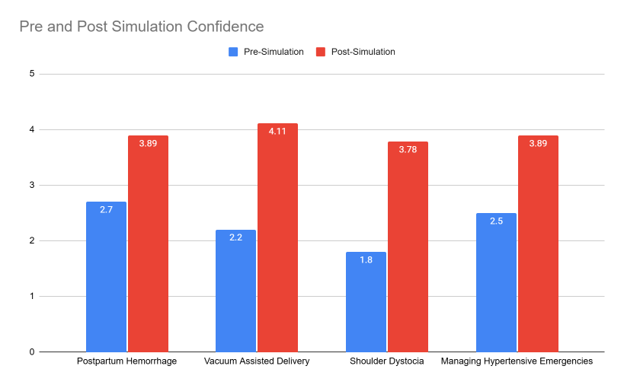
All 10 participants completed surveys before and after the training to assess their confidence in managing obstetric emergencies. Confidence was measured using a 5-point Likert-type scale, with 1 indicating “not at all confident” and 5 indicating “very confident.” Mean confidence across the assessed domains increased from 2.3 before training to 3.9 after training (Figure 1).
Subjective feedback and comments were also collected for 6 months after the simulation training. Six of the 10 participants reported encountering obstetric emergencies in clinical practice, including shoulder dystocia, postpartum hemorrhage, and vacuum-assisted delivery. All 6 reported that the realistic, hands-on simulation practice improved their performance during these clinical encounters.
Figure 1:
CONCLUSIONS
As the proportion of family physicians providing obstetric care continues to decline and maternity care deserts in rural and underserved areas continue to expand, creative approaches to obstetric training are needed both during and after residency. The most recent survey from the American Board of Family Medicine reports that only 11% of family physicians practice obstetrics. Among physicians who do not practice obstetrics, 19% report inadequate residency training as a reason.5
High-fidelity simulation shows promise as an approach to enhancing resident education and obstetric training. Other residency programs might consider partnering with local or state organizations to incorporate high-fidelity simulation into their obstetric curricula.
Next steps for this program include increasing the number of residents who participate in the training and adding a skills checklist to assess whether the training improves not only confidence but also competence.
REFERENCES
- Sonenberg A, Mason DJ. Maternity care deserts in the US. JAMA Health Forum. 2023;4(1). doi:10.1001/jamahealthforum.2022.5541
- Barreto TW, Eden AR, Petterson S, Bazemore AW, Peterson LE. Intention versus reality: family medicine residency graduates' intention to practice obstetrics. J Am Board Fam Med. 2017;30(4):405-406. doi:10.3122/jabfm.2017.04.170120
- Weidner AKH, Phillips RL Jr, Fang B, Peterson LE. Burnout and scope of practice in new family physicians. Ann Fam Med. 2018;16(3):200-205. doi:10.1370/afm.2221
- Huang J, Tang Y, Tang J, et al. Educational efficacy of high-fidelity simulation in neonatal resuscitation training: a systematic review and meta-analysis. BMC Med Educ. 2019;19(1):323. doi:10.1186/s12909-019-1763-z
- American Board of Family Medicine; Association of Family Medicine Residency Directors. 2025 National Graduate Survey Report. Published April 2026. Accessed August 7, 2026.
Want to Read More STFM Education Columns or Learn How to Submit One?
Visit the STFM Education Column homepage for more information.