Study Resource Preferences for the Family Medicine Clerkship Examination
BACKGROUND
The Family Medicine NBME end-of-clerkship examination covers an exceptionally broad spectrum of clinical content. Despite its importance, little is known about which specific study resources best support medical students in their exam preparation. Presently, students are advised to read textbook chapters, journal articles, practice multiple-choice questions (MCQ), review screening guidelines, study case-based texts, etc.
A 2006 survey of third-year internal medicine clerkship students found that although students read frequently, they often struggled to judge which resources were most useful for their level of training.1 More recently, a multi-institutional study of reading and study habits among mid-year, third-year clerkship students found that the specific resources and strategies students chose were associated with meaningful differences in exam performance, underscoring that not all study approaches are equally effective.2 At the same time, research suggests that students are increasingly turning to third-party learning resources rather than traditional textbooks and journal articles, and in some cases are using these resources to supplant traditional clerkship study materials.3 Flashcard platforms built on spaced repetition, such as Anki, have in particular been associated with improved academic performance across multiple areas of medical education, although the supporting evidence remains heterogeneous in both methodology and underlying learning theory.4 Taken together, these findings suggest that the landscape of clerkship study resources has shifted substantially, yet clerkship directors and students continue to lack clear, specialty-specific guidance on which resources are most effective for Family Medicine NBME exam preparation.
Because most Family Medicine clerkships utilize the NBME exam as a significant portion of the final grade, identifying effective study materials is critical for student success and for clerkship directors providing guidance. This project sought to identify which resources students utilize and which they perceive as most and least effective for exam preparation.
METHODS
Medical students at Tulane University School of Medicine (New Orleans, LA) who completed their Family Medicine clerkship were invited to participate in a voluntary, anonymous Qualtrics (Provo, UT) survey midway through the 2023–2024 academic year. We administered the survey online and distributed it to eligible students at the end of the fall semester. Of the 130 students who completed the clerkship and were invited to participate, 61 (47%) completed the survey in its entirety. We asked students to identify the study resources they found most and least helpful and to provide qualitative feedback via free-text comments on study strategies.
RESULTS
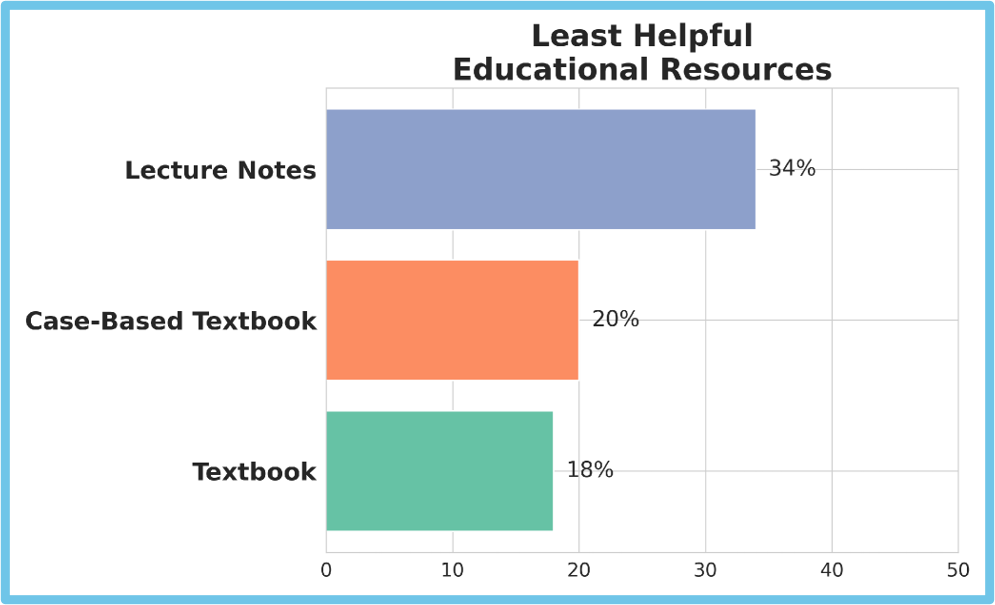
The data revealed a strong preference for third-party interactive learning and digital platforms. Overall, students found doing MCQ the most helpful. Students rated lectures, textbooks, and case-based texts as the least helpful. Most used educational resources are presented in Figure 1, and student ratings of the most and least helpful resources are presented in Figures 2 and 3, respectively.
In free-text comments, several qualitative themes emerged. Students frequently noted that because the Family Medicine NBME exam covers such a broad spectrum of content, it was easy to become overwhelmed by the number of available study resources. Many students also perceived a discrepancy between NBME practice exams and the actual exam, describing the real exam as “exceptionally more difficult and nuanced.” Additionally, students emphasized the value of discussing clinically challenging topics directly with preceptors at the point of care.
Figure 1: Most Used Educational Resources Reported by Students During Their Family Medicine Clerkship
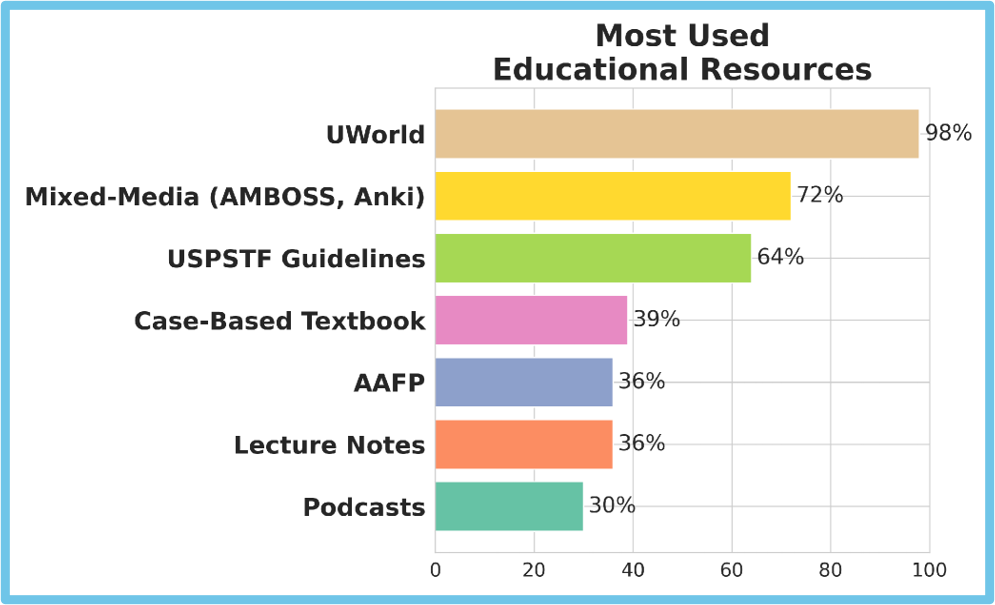
Figure 2: Educational Resources Rated as Most Helpful by Students
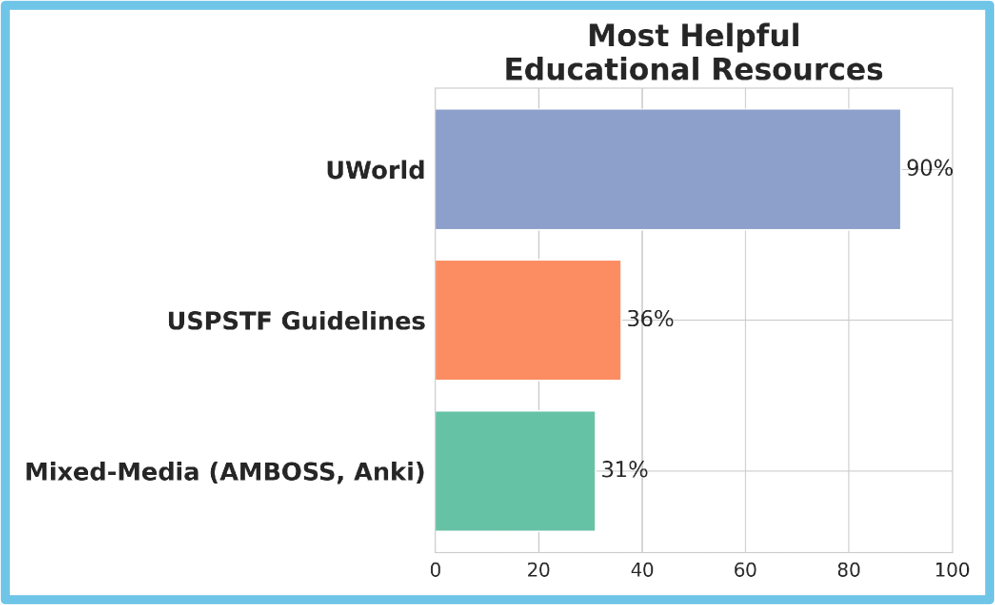
Figure 3: Educational Resources Rated as Least Helpful by Students
DISCUSSION
The results indicate a significant shift toward digital and interactive platforms over traditional lectures and passive reading. Students’ perception that the NBME exam is more difficult and nuanced than practice materials suggests that successful exam preparation in Family Medicine requires not only content exposure but also structured, active engagement with material that mirrors real exam expectations. Tools that promote spaced repetition, frequent retrieval practice, clinical reasoning, and longitudinal reinforcement, such as question banks and mixed-media platforms, appear better suited to address the demands of the NBME exam than passive reading of lecture notes, textbook chapters, or case-based texts alone. Students’ emphasis on the value of discussing challenging topics with preceptors at the point of care suggests that preceptor-led teaching within a clinical framework remains an important complement to self-directed learning.
These findings add to a growing body of literature describing a shift away from traditional lectures and textbook-based study toward third-party, technology-based learning resources.3,4 While prior work has documented this shift broadly across preclerkship and clerkship training,2,3 this study extends those findings specifically to the Family Medicine clerkship and preparation for the Family Medicine NBME shelf exam. By identifying which resources students perceive as most and least helpful for this exam, this study offers clerkship directors more targeted guidance and supports incorporating discussion of high-yield, active-learning resources into clerkship orientation.
This study has several limitations. It was conducted at a single institution with a modest sample size (n = 61, 47% response rate), which may limit the generalizability of findings to other institutions or regions. Data on resource use and perceived helpfulness were self-reported and collected retrospectively at the end of the clerkship, introducing some degree of recall bias. The survey did not objectively measure exam performance in relation to specific study resources, so associations between resource use and actual outcomes cannot be established, and students’ perceptions of helpfulness may not fully reflect a resource’s true effect on performance. Students with strong opinions about their study strategies, whether positive or negative, may also have been more likely to respond.
For medical education more broadly, these findings suggest that clerkship curricula may benefit from explicitly incorporating guidance on high-yield, active-learning resources rather than assuming students will independently identify effective study strategies. Clerkship directors may also consider periodically resurveying students to keep pace with the rapidly evolving landscape of third-party educational technology and integration of artificial intelligence into this educational space. Future multi-institutional studies that link specific resource use to objective exam performance would help validate and extend these findings.
CONCLUSION
Based on this survey, students are advised to answer MCQ over a spaced-out timeframe, study USPSTF guidelines early, use mixed-media platforms for targeted study, and discuss complex topics with their preceptor.
REFERENCES
-
Leff B, Harper GM. The reading habits of medicine clerks at one medical school: frequency, usefulness, and difficulties. Acad Med. 2006;81(5):489-494. doi:10.1097/01.ACM.0000222273.90705.a6
-
Kind T, Olvet DM, Farina G, et al. Reading and Study Habits of Medical Students on Clerkships and Performance Outcomes: a Multi-institutional Study. Med Sci Educ. 2021;31(6):1957-1966. Published 2021 Sep 29. doi:10.1007/s40670-021-01409-5
-
Lawrence ECN, Dine CJ, Kogan JR. Preclerkship Medical Students’ Use of Third-Party Learning Resources. JAMA Netw Open. 2023;6(12):e2345971
-
Frappa N, Chernov D, Dillon M, Alben MG. Anki Use and Academic Performance in Medical Education: A Systematic Review of Evidence and Learning Theory. Med Sci Educ. 2026;36(2):1015-1025. Published 2026 Jan 17. doi:10.1007/s40670-026-02643-5
Want to Read More STFM Education Columns or Learn How to Submit One?
Visit the STFM Education Column homepage for more information.