A Low-Burden Multilingual Patient Feedback System for Resident Assessment in Family Medicine Continuity Clinic
BACKGROUND
Patient perspectives are increasingly recognized as an important component of competency-based medical education (CBME).1 The ACGME requires residency programs to assess residents across core competencies, including communication skills and professionalism, using Clinical Competency Committees that synthesize data from multiple assessment sources.2 The STFM CBME Task Force has published recommendations emphasizing robust assessment systems in family medicine.3,4 Despite this, patient feedback remains underutilized in residency training.1,5
A systematic review found that patient feedback can positively influence physician performance.6 However, multiple barriers exist including language, accessibility, resident concerns about receiving feedback, and limited feedback-seeking cultures.1,5,7,8 Psychological safety strategies, including positioning educators as allies and encouraging dialogue, can mitigate some of these concerns.9
Our program previously utilized Press Ganey metrics but in 2024 and 2025, residents received no Press Ganey patient feedback. Validated instruments such as the Communication Assessment Tool (CAT) exist but can be resource-intensive.10,11,12 We sought to create a brief, multilingual, resident-specific feedback process integrated into existing clinic workflows while minimizing administrative burden and supporting psychological safety.
METHODS
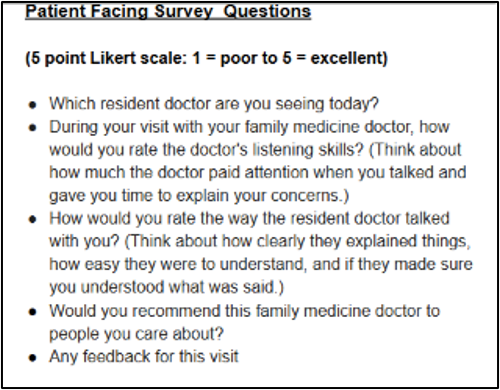
In August 2025, our family medicine residency launched a patient-to-resident feedback initiative. A brief survey was developed in English, and translated into Spanish, Portuguese, and Haitian Creole (Figure 1). Patients rated residents on listening, communication, and likelihood of recommending the resident, with optional free-text feedback.
One resident per week was designated as the focus resident. Medical assistants distributed QR codes at the start of the visit and supported survey completion using standardized talking points. To support psychological safety, feedback was shared only with residents and advisors and not used to assess residents’ standing in the program.
Resident perceptions were assessed before and after implementation using a 4-point Likert scale survey, evaluating comfort and anxiety with receiving patient feedback, perceived educational value, and anticipated impact of patient feedback.
Figure 1: Feedback Form From Patients During Resident Visit in English Language
RESULTS
Between August 2025 and March 2026, 191 patient responses were collected across four languages (English: 98; Portuguese: 49; Spanish: 23; Haitian Creole: 21). All residents received feedback, with 2-17 responses per resident (Table 1).
Resident perceptions remained favorable throughout implementation (Table 2). Mean comfort receiving patient feedback remained high before and after implementation (3.64 vs 3.40), while anxiety remained low (2.18 vs 2.00). Residents consistently agreed that patient feedback provided meaningful insights (3.64 vs 3.80) and represented a valuable component of training (3.45 vs 3.60). Perceptions regarding the potential of patient feedback to improve quality of care were similarly favorable before and after implementation (3.45 vs 3.30).
Table 1: Implement Outcomes of the Patient-to-Resident Feedback Initiative
|
Measure |
Result |
|
Implementation period |
8 months (Aug 2025 - Mar 2026) |
|
Total patient responses |
191 |
|
English responses |
98 (51.3%) |
|
Portuguese responses |
49 (25.7%) |
|
Spanish responses |
23 (12.0%) |
|
Haitian Creole responses |
21 (11.0%) |
|
Residents receiving feedback |
All residents (24/24) |
|
Responses per resident |
2 - 17 |
DISCUSSION
A multilingual patient feedback system was successfully integrated into the continuity clinic with minimal workflow disruption. Limiting collection to one resident per week addressed resource constraints identified in prior work.12 Engaging medical assistants as educational stakeholders was critical to facilitating patient feedback form completion. Explicit psychological safety measures, including ensuring results were shared with residents and their advisors, promoted resident acceptance.
Decreased anxiety and increased perceived value after participation suggest that patient feedback may be more acceptable to residents than anticipated when implementation is transparent and formative.
Limitations include single-institution design, a non-validated survey instrument, and lack of long-term outcome evaluation. Future work could evaluate changes in patient satisfaction after feedback and align questionnaire items with ABFM core outcomes to assess preparedness for independent practice and inform Clinical Competency Committee assessments.
CONCLUSION
A structured, multilingual patient feedback process can be implemented in residency continuity clinics while maintaining psychological safety and minimizing workflow burden. Incorporating patient voices may strengthen competency-based assessment as family medicine advances toward CBME.
REFERENCES
-
Khalife R, Gupta M, Gonsalves C, et al. Patient involvement in assessment of postgraduate medical learners: A scoping review. Med Educ. 2022;56(6):602-613. doi:10.1111/medu.14726
-
Accreditation Council for Graduate Medical Education. Common Program Requirements (Residency). ACGME; 2026. Accessed June 13, 2026. https://www.acgme.org/globalassets/pfassets/programrequirements/2026-prs/cprresidency_2026.pdf
-
Tulshian P, Montgomery L, McCrory K, et al. National Recommendations for Implementation of Competency-Based Medical Education in Family Medicine. Fam Med. 2025;57(4):253-260. doi:10.22454/FamMed.2025.866091
-
Cooper D, Holmboe ES. Competency-Based Medical Education at the Front Lines of Patient Care. N Engl J Med. 2025;393(4):376-388. doi:10.1056/NEJMra2411880
-
Stoesser K, Van Hala S, Hunt J, Fortenberry KT, Kiraly B. Integration of Patient Feedback in Family Medicine Residency Programs: A CERA Study. Fam Med. 2026;58(7):495-503. https://doi.org/10.22454/FamMed.2026.357146
-
Baines R, Regan de Bere S, Stevens S, et al. The impact of patient feedback on the medical performance of qualified doctors: a systematic review. BMC Med Educ. 2018;18(1):173. Published 2018 Jul 31. doi:10.1186/s12909-018-1277-0
-
Shafian S, Ilaghi M, Shahsavani Y, et al. The feedback dilemma in medical education: insights from medical residents' perspectives. BMC Med Educ. 2024;24(1):424. Published 2024 Apr 19. doi:10.1186/s12909-024-05398-y
-
Huffman BM, Hafferty FW, Bhagra A, Leasure EL, Santivasi WL, Sawatsky AP. Resident impression management within feedback conversations: A qualitative study. Med Educ. 2021;55(2):266-274. doi:10.1111/medu.14360
-
Johnson CE, Keating JL, Molloy EK. Psychological safety in feedback: What does it look like and how can educators work with learners to foster it?. Med Educ. 2020;54(6):559-570. doi:10.1111/medu.14154
-
Makoul G, Krupat E, Chang CH. Measuring patient views of physician communication skills: development and testing of the Communication Assessment Tool. Patient Educ Couns. 2007;67(3):333-342. doi:10.1016/j.pec.2007.05.005
-
Myerholtz L, Simons L, Felix S, et al. Using the communication assessment tool in family medicine residency programs. Fam Med. 2010;42(8):567-573. PMID: 20830622
-
Mahoney D, Bogetz A, Hirsch A, et al. The challenges of multisource feedback: feasibility and acceptability of gathering patient feedback for pediatric residents. Acad Pediatr. 2019;19(7):833-840. doi:10.1016/j.acap.2018.12.007
Want to Read More STFM Education Columns or Learn How to Submit One?
Visit the STFM Education Column homepage for more information.