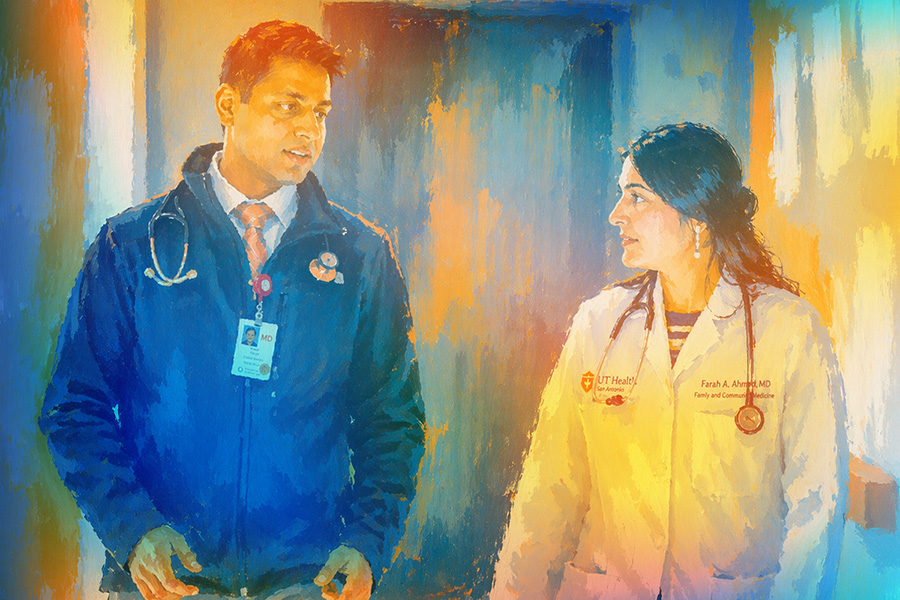
An STFM Professionalism in Family Medicine Education Task Force, chaired by STFM Past President Joe Gravel, MD, is working on tactics to support family medicine faculty as they seek to teach professionalism in an era where physicians are challenged with upholding the best interests of patients while taking into account the goals of the institutions or practices that employ them.
Goals of the Professionalism Initiative and Task Force
Convene a Professionalism in Family Medicine Summit
The 2025 Professionalism in Family Medicine Summit brought together leaders from family medicine residency and academic departments, certifying and accrediting bodies, and professional societies to reexamine the meaning, teaching, and assessment of professionalism in an era of rapid cultural and systemic change. Over two days, participants identified opportunities for innovation and collaboration, and brainstormed strategies for embedding professionalism in both training and practice.The Summit was co-sponsored by the American Medical Association and funded by a grant from the ABFM Foundation.Summit goals were to:
- Discuss future directions for family medicine professionalism expectations
- Develop strategies for faculty and physician education/development
- Get input on future curriculum
- Identify opportunities for collaboration
- Define next steps
Develop and Release Professionalism Curriculum for Residents and 3rd- and 4th-year Medical Students
The scenario-based curriculum will cover:
- The founding principles of family medicine
- How to identify and mitigate inherent business/medical professionalism conflicts
- How to maintain integrity in settings that are more systems-focused than patient-focused
- When and how to advocate for change
Identify or Create Competency-Based Assessment Tools
The task force will identify or create strategies to assess learners and faculty.
Deliver Faculty Development
Faculty development will be done through:
- Conference presentations
- Virtual training sessions (webinars)
- Faculty Development Delivered workshops at individual residency programs
Faculty development topics will include:
- Creating learning environments conducive to the ongoing development of “explicit and appropriate professional behaviors” in students, residents, faculty, and staff
- How to foster professionalism based on intrinsic motivation, rather than on a list of rules
- Assessing professionalism, and strategies for addressing professionalism lapses
Presentations
Presentations Submitted or Accepted for 2027 Conferences
The following presentations have been submitted for 2027 conferences:
- STFM Conference on Medical Student Education
- Bringing Family Medicine Professional Identity to Medical Students: Strategies for Early Clinical Learners
- AAFP Residency Leadership Summit
- “Results of the STFM Professionalism in Medical Education Taskforce
- STFM Annual Spring Conference
- The Facilitator’s Toolbox: Level Up your Small Group Teaching Skills
- Try It, Then Teach It: Experiencing the STFM Professionalism Curriculum for Residency Programs
- Modeling, Teaching, and Assessing Professionalism: Delivering on the Promise of the Social Contract
Presentations Completed for 2027 Conferences
- 2026 Family Medicine Education Leadership Consortium
- Redefining Professionalism: Family Medicine’s Multi-Organization Approach
- 2026 STFM Annual Spring Conference
- Teaching and Assessing a New Professionalism: A Discussion With the STFM Task Force on Professionalism in Medical Education
- July 2026 ADFM Webinar
- Teaching and Assessing Professionalism in an Era of Corporate Medicine 2
- 2026 STFM Conference on Practice and Quality Improvement
- The Role of Behavioral Health Faculty in Teaching and Assessing Professionalism in an Era of Corporate Medicine
- Teaching and Assessing a New Professionalism: A Discussion with the Chair of the STFM Professionalism Task Force
STFM Professionalism in Family Medical Education Task Force
- Joseph Gravel, MD, Chair of Family and Community Medicine, Medical College of Wisconsin
- John Brady, MD, Associate Professor, VCU-Riverside Family Medicine Residency
- Daniel Casey, MD, Program Director, JPS Family Medicine Residency
- Amy Clithero, PhD, MBA, Director for Medical Student Education on Health Policy & Advocacy, University of New Mexico School of Medicine
- Roger Garvin MD, Director of GME Integration and Expansion, Oregon Health & Science University
- Lauren Gibson-Oliver, MD, MBA, Residency Program Director, University of Arkansas for Medical Sciences
- Lynne Havsy, PhD, Assistant Director of Behavioral Science and Resident Development Anderson Family Medicine Residency Program
- Joshua Hodge, MD, Program Director, Florida State University Family Medicine Residency
- Timothy Hoff, PhD, Professor of Management, Healthcare Systems, and Health Policy, Northeastern University, Boston, MA
- Natalie Long, MD, Family Medicine Clerkship Director, University of Missouri-Columbia
- C.J. Peek, PhD, Professor, Dept of Family Medicine and Community Health, University of Minnesota Medical School
- Adam Saperstein, MD, Associate Professor and Vice Chair for Medical Education, Uniformed Services University of the Health Sciences
- Takudzwa Shumba, MD, MPH, Clinical Associate Professor, Stanford University School of Medicine
- Mary Theobald, MBA, Chief of Strategy and Innovation, Society of Teachers of Family Medicine
- Maria Montanez Villacampa, MD, Residency Associate Program Director, University of Texas Health Science Center-San Antonio