Utilizing Technology in Medical Education to Foster Health Equity: A QR Code Walking Tour About Combating Racism in Medicine
Introduction
In 2003, the Institute of Medicine released Unequal Treatment, highlighting how bias, prejudice, and stereotyping contribute to disparities in health care.¹ Yet, racial and ethnic minorities continue to experience worse health outcomes for many chronic, treatable conditions.² In 2020, two major events brought racial injustice to the forefront: the death of George Floyd and the COVID-19 pandemic, which disproportionately affected Black, Hispanic/Latino, American Indian/Alaska Native, and Native Hawaiian communities.³
Amid growing calls for racial justice, medical students and others demanded curricular changes to address racism’s role in health disparities. Recognizing this gap in our curriculum, we created a QR code walking tour across our medical school campus. The goal was to make information about racism in medicine more accessible and engaging. By using QR codes, we aimed to increase awareness of historical and structural racism in medicine while capturing engagement through the number of scans.
Method
Development
This project was deemed exempt by the institutional review board (IRB 0065-22-EX).
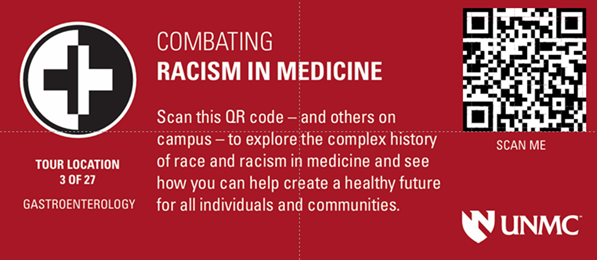
A QR code (quick response code, figure 1) is a type of barcode that smartphones can scan to access text, websites, images, or videos. In medical education, QR codes have been used in poster presentations, lecture slides, and interactive learning tools.
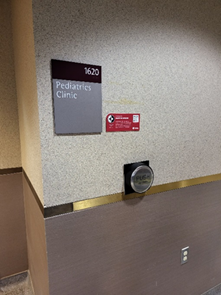
We placed QR codes at 27 locations (figure 2) across the medical campus, chosen in collaboration with faculty, the Office of Diversity, Equity, and Inclusion, and hospital administrators.
Each QR code linked to media content—videos, articles, interviews, quizzes, and e-modules—highlighting racial inequities in research, education, and health care.
Tables
Table 1. University campus location and health equity information link
|
Department |
Health Equity Topic |
OR code link |
|
Internal medicine |
Quiz about SDOH in Omaha |
unmcqrcodetour.tiny.us/2p8yprpp |
|
Family medicine |
Quiz about health disparities in Omaha |
unmcqrcodetour.tiny.us/y6c7usx9 |
|
ER |
Bias in the treatment of pain |
unmcqrcodetour.tiny.us/4yzyt628 |
|
Cardiology |
Slavery hypertension hypothesis |
unmcqrcodetour.tiny.us/eunkdbds |
|
Peds |
Lead exposure in North Omaha |
unmcqrcodetour.tiny.us/2x4zehes |
|
LGBTQ+ |
Transgender discrimination |
unmcqrcodetour.tiny.us/54rsp63c |
|
Surgery |
Racial and ethnic disparities in transplantation Racial minorities in the surgery workforce |
unmcqrcodetour.tiny.us/y2wu6nef |
|
Research |
Tuskegee Experiment US Syphilis Study |
unmcqrcodetour.tiny.us/y9amw6nm |
|
Pulmonary |
Race correction in spirometry |
unmcqrcodetour.tiny.us/3uzy9ykc |
|
Psychiatry |
Structural racism in psychiatry Racism and mental health |
unmcqrcodetour.tiny.us/3wcxsajw |
|
Pathology/microbiology |
Henrietta Lacks and HeLa cells |
unmcqrcodetour.tiny.us/yc2kzzfa |
|
OBGYN |
Dr. J Marion Sims Maternal mortality rates in minorities Mississippi Appendectomy |
unmcqrcodetour.tiny.us/564rudup |
|
Nephrology |
Kidney disease, race, and ethnicity |
unmcqrcodetour.tiny.us/3fsybt5h |
|
ID |
Racial disparities in infectious diseases |
unmcqrcodetour.tiny.us/ycku5rjp |
|
Medical education |
Explanation of our project, the QR code walking tour |
unmcqrcodetour.tiny.us/34c493jv |
|
Hospital history |
History of segregated hospitals in Omaha |
unmcqrcodetour.tiny.us/bdf5dnuj |
|
Gastro |
Rates of colon cancer in African Americans |
unmcqrcodetour.tiny.us/2p8854c9 |
|
Derm |
Racial differences in melanoma Diversity of skin images in medical textbooks |
unmcqrcodetour.tiny.us/2p83br66 |
|
DEI office |
Information about UNMC DEI department |
unmcqrcodetour.tiny.us/2zcc8yhu |
|
Art/humanities |
Art and healing, links to visual art, poetry, art by Black artists |
unmcqrcodetour.tiny.us/2a3h6mpr |
|
Anatomy/genetics |
Eugenics and phrenology |
unmcqrcodetour.tiny.us/bds2kvu5 |
|
Alumni- Dr. Hunter |
Notable alum of UNMC Class of 1962 |
unmcqrcodetour.tiny.us/2wa74deb |
|
Alumni- Dr Harris |
Notable alum of UNMC Class of 1962 |
unmcqrcodetour.tiny.us/2p96ecm8 |
|
Alumni- Dr. Bookhardt |
Notable alum of UNMC Class of 1959 |
tinyurl.com/3vzt557u |
|
Alumni- Dr Conner |
Notable alum of UNMC Class of 1957 |
unmcqrcodetour.tiny.us/bddh567v |
|
Admissions |
Underrepresented minorities in medicine |
tinyurl.com/qrcodetour2 |
|
PMR |
Quiz about stroke and disability in minorities |
Departmental diversity, equity, and inclusion (DEI) teams offered suggestions about which issues to highlight within their specialties that affect racial and health equity. For example, the pulmonology QR code linked to discussions about race-based adjustments in spirometry; the pathology QR code featured the story of Henrietta Lacks and HeLa cells; and the admissions office QR code provided data on underrepresented minorities in medicine.
To maximize engagement, QR codes were placed in clerkship areas where third-year medical students rotate. They were located in visible areas near departmental signage and outside badge-access doors, ensuring access to faculty, students, and staff at all times.
Upon scanning a QR code, users had the option to complete a pre-survey that collected:
- Demographic information
- Self-reported knowledge of institutional racism in medicine
- Attitudes toward providing care for racial minorities
- Prior involvement in caring for racial minority populations
A follow-up survey was sent 6 months after a user’s initial scan to reassess these areas. Users could opt in to receive the follow-up via their mobile phone number.
Results
Medical educators must recognize and address racism to create a health care system that serves all patients equitably. Our project offered a curated set of resources—some newly developed, others preexisting—to engage learners in understanding racism’s impact in medicine. The QR codes, developed through cross-departmental collaboration, highlighted efforts within various specialties to reduce racial disparities—from dermatology’s skin-of-color clinic to updated kidney function measurements and initiatives to increase colorectal cancer screening among Black communities.
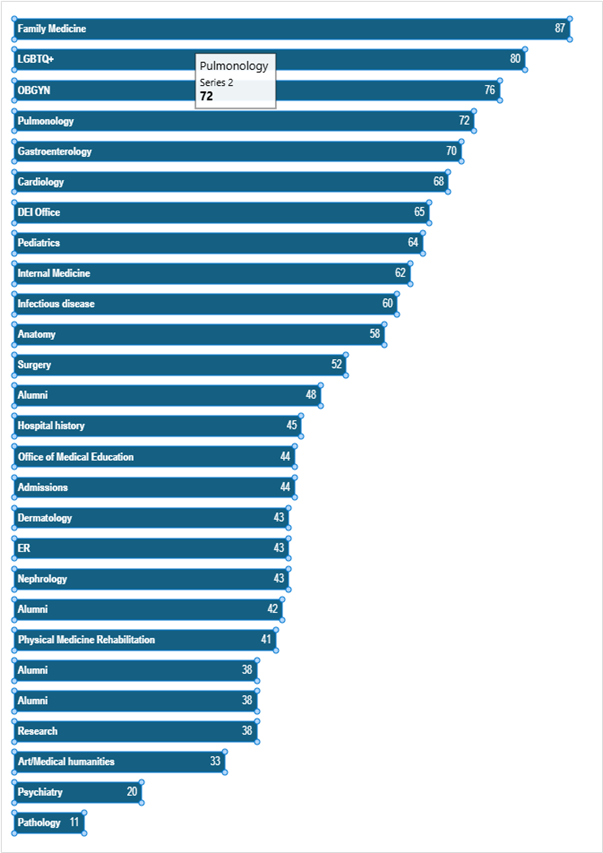
The QR codes received more than 1000 clicks, primarily from students, demonstrating strong interest and engagement. Many students found the tour valuable, though some noted challenges with the walking aspect and suggested group discussions to accompany the material.
As DEI efforts face headwinds across institutions, our QR codes serve as a lasting, visible tool for education. They offer a scalable and accessible way to address racism in medicine, even as broader institutional initiatives encounter uncertainty.
Discussion
Medical educators must recognize and address racism to create a health care system that serves all patients equitably. Our project offered a curated set of resources—some newly developed, others preexisting—to engage learners in understanding racism’s impact in medicine. The QR codes, developed through cross-departmental collaboration, highlighted efforts within various specialties to reduce racial disparities—from dermatology’s skin-of-color clinic to updated kidney function measurements and initiatives to increase colorectal cancer screening among Black communities.
The QR codes received more than 1000 clicks, primarily from students, demonstrating strong interest and engagement. Many students found the tour valuable, though some noted challenges with the walking aspect and suggested group discussions to accompany the material.
As DEI efforts face headwinds across institutions, our QR codes serve as a lasting, visible tool for education. They offer a scalable and accessible way to address racism in medicine, even as broader institutional initiatives encounter uncertainty.
References
- Smedley BD, Stith AY, Nelson AR, eds. Unequal Treatment: Confronting Racial and Ethnic Disparities in Health Care. National Academies Press; 2003.
- Office of Minority Health. Black/African American—The Office of Minority Health. Published August 22, 2019. Accessed June 19, 2025. https://www.minorityhealth.hhs.gov/omh/browse.aspx?lvl=3&lvlid=61
- Tai DBG, Sia IG, Doubeni CA, Wieland ML. Disproportionate impact of COVID-19 on racial and ethnic minority groups in the United States: a 2021 update. J Racial Ethn Health Disparities. 2022;9(6):2334-2339. doi:10.1007/s40615-021-01170-w