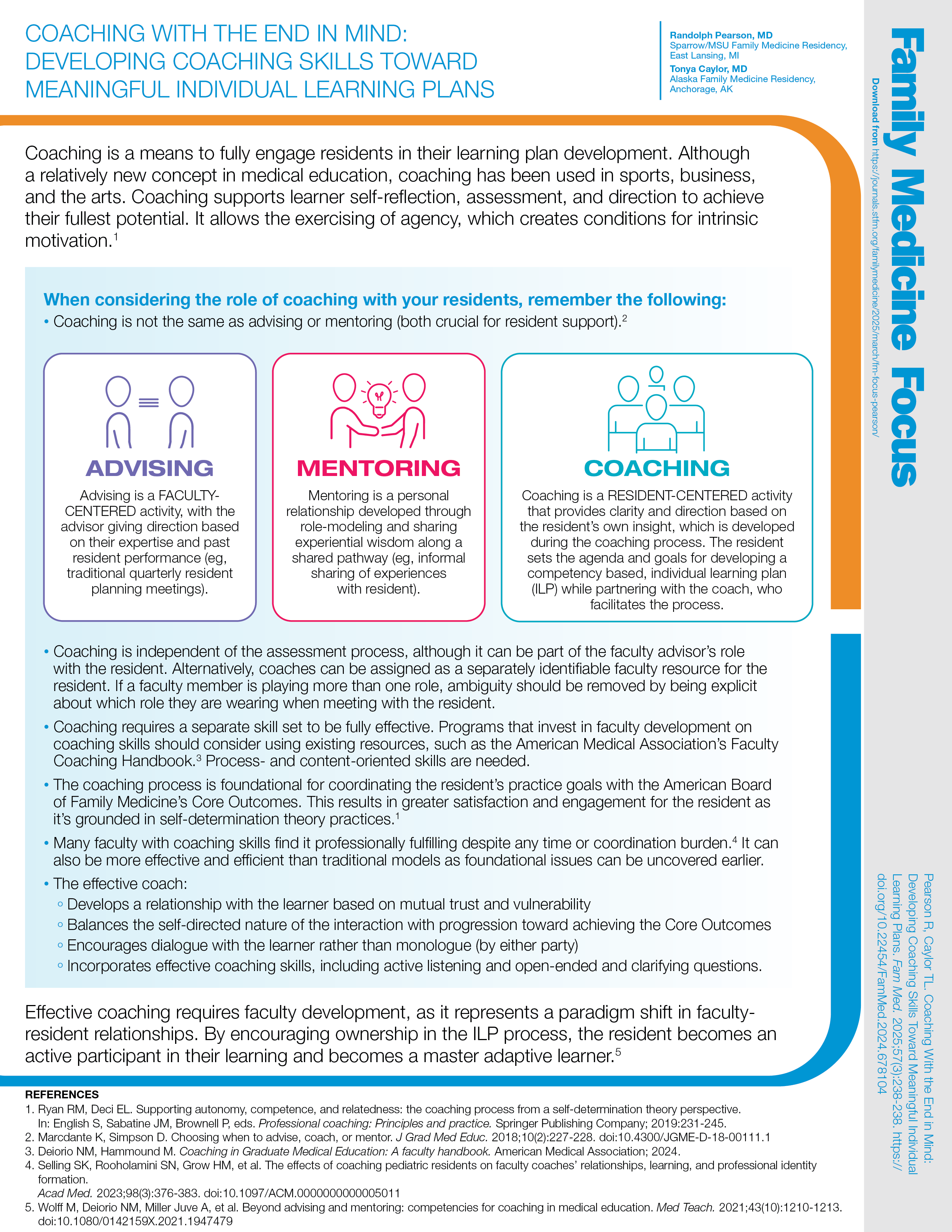
Coaching of residents has been proposed as a means to more fully engage residents in their personal development of learning plans. Although a relatively new concept in Medical Education, coaching has been used as a valuable resource in sports, business, the military, and the arts. When fully engaged, the learner accepts ownership of the learning plan and is more likely to succeed.When considering the role of coaching with your residents, remember the following:
- Coaching is not the same as advising or mentoring, which are both also important for resident support. Coaching is a RESIDENT-CENTERED activity where the resident develops a learning plan with the guidance of faculty. Advising is a FACULTY-CENTERED activity where the resident’s education is guided in large part by previous performance. Mentoring is a personal relationship developed through role-modeling by a faculty member or other individual.
- Coaching is independent of the assessment process, although it can be a part of the faculty advisor’s role with the resident. Alternatively, coaches can be assigned as a separately identifiable faculty resource for the resident.
- Coaching requires a separate skill set in order to be fully effective. Programs that invest in faculty development on coaching skills should consider using resources such as the "Coaching in Medical Education—A Faculty Handbook” (PDF) to guide their faculty development efforts.
- Faculty and residents may perceive an additional burden resulting from engaging in coaching activities. Faculty should remember that this process is resident-driven, with the goal of coordinating the resident’s own practice goals with the ABFM Core Outcomes. Ultimately, this coordination results in greater satisfaction and engagement on the part of the resident, as their training is focused on their individualized target at the same time that it assures fulfillment of the Core Outcomes.
- The effective coach has a developed relationship with the learner based on mutual trust and vulnerability, balances the self-directed nature of the interaction with progression toward achieving the Core Outcomes, and encourages dialogue with the learner rather than monologue (either by coach or learner)